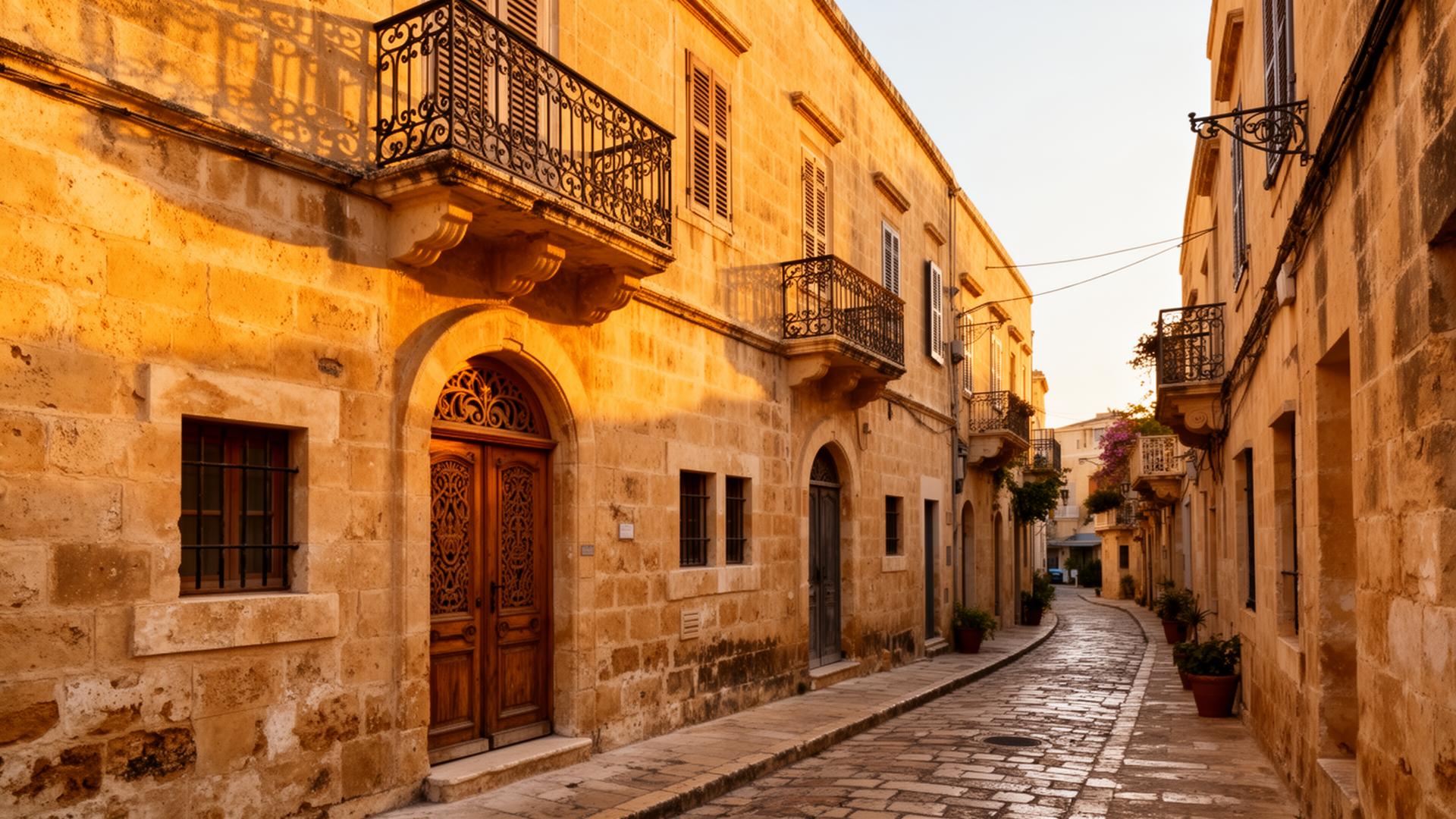
The house sits on a lane so narrow that the architect's car could not reach the front door. For four years, every beam of chestnut, every Lefkara-stitched panel and every sack of lime mortar arrived by hand-cart from the corner of Onasagorou Street. The result is a private home of roughly 410 square metres, organised around a courtyard you cannot see from the street and would not guess existed.
A house that was almost lost
When the current owners — a Cypriot-Lebanese couple who had been searching the old city for two years — first walked in, the ground floor was a textile warehouse and the upper floor had been closed since 1974. Sections of the timber ceiling had collapsed onto a Victorian piano nobody had moved. The carved double doors, miraculously, were intact. So was the wellhead in the courtyard. Almost everything else was a careful argument between the conservation authorities, the architect (Pavlos Constantinou) and a small team of craftspeople drawn largely from the village of Lefkara.

What was kept, what was rebuilt
- Façade: untouched except for a deep clean and the replacement of three sandstone blocks below the iron balcony.
- Ground floor: original limestone slabs lifted, numbered, and relaid over a new insulated slab with underfloor heating.
- Piano nobile: chestnut ceiling reconstructed using 70% original timber; the missing 30% sourced from a demolished house in Larnaca's Skala district.
- Courtyard: the wellhead is original and functional; the pool is new, lined in pale Karystos marble, and deliberately shallow (1.2 m) to keep the water still.
- Textiles: every soft furnishing was woven in Lefkara to specifications drawn from a single surviving 1890s curtain found behind a wardrobe.
The quiet thesis
"We did not want a museum. We wanted a house that a child could grow up in without being told not to touch things. Everything had to be repairable by a craftsman who is still alive."
That last line is the discipline of the project. No marble nobody on the island can re-cut. No lighting system that depends on a single Italian supplier. No glazing that cannot be re-leaded by the same workshop in Strovolos that did the originals. It is restoration as a long-term operating decision, and it is, quietly, one of the most successful private homes built — or rather rebuilt — in the capital this decade.