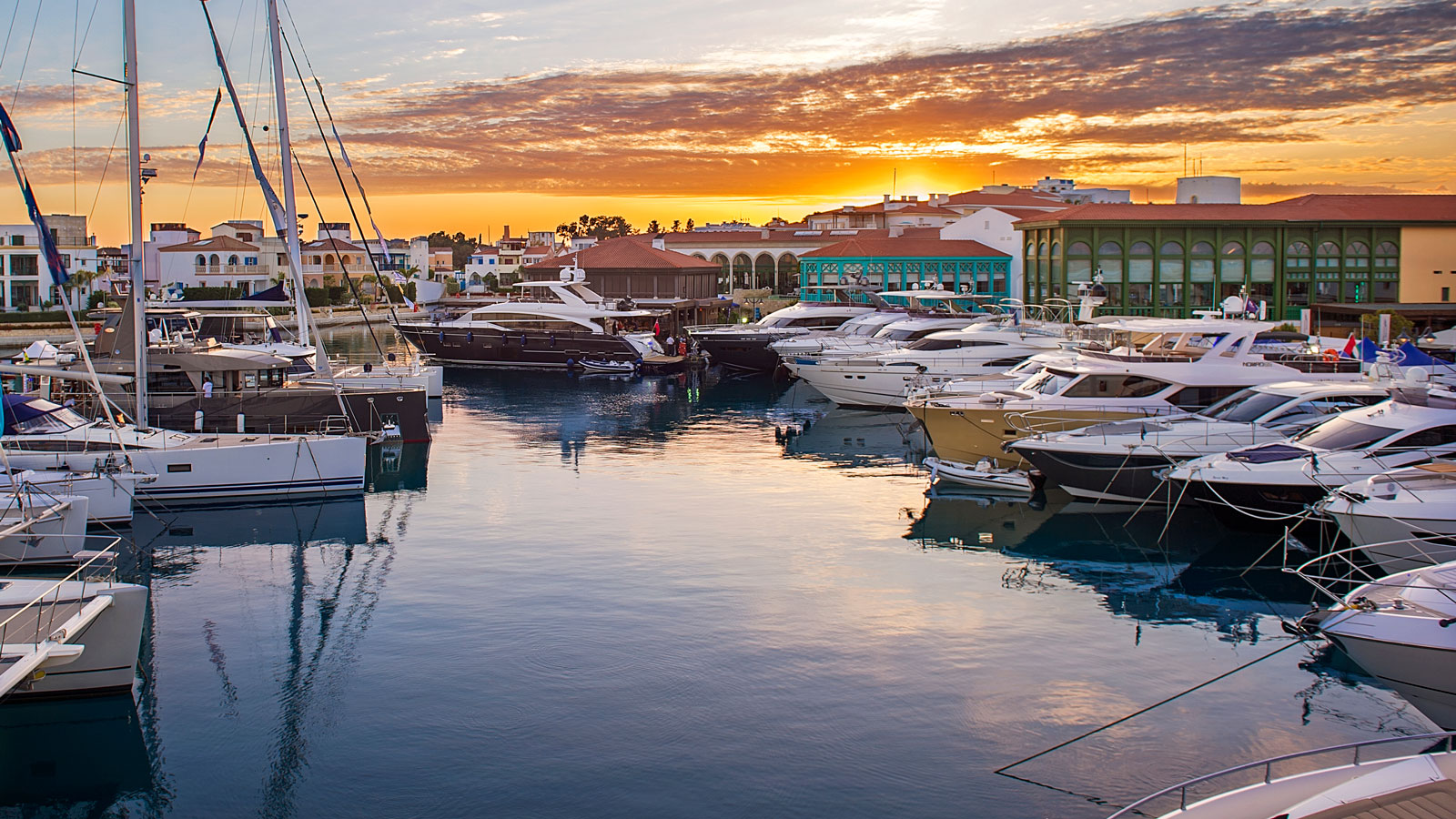
Six years after the last berth was sold, Limassol Marina has settled into something its developers never quite promised: not a lifestyle resort, but a financial district with a sea view. The half-mile crescent between the breakwater and the old town is now the single most liquid postcode in Cyprus — and, on every metric we track, the most defensive.
Between Q1 2024 and Q1 2026 the average price per square metre inside the marina perimeter rose 28%, against an island-wide figure of 11%. More telling, the volatility of that line is roughly a third of the national series. The marina does not surge; it compounds.
Why the perimeter behaves differently
Three structural forces explain the divergence. First, supply: the marina is, by deed, finite. There will be no second phase, no adjacent tower, no rezoning. Roughly 240 residences exist and roughly 240 always will. Second, the buyer base has rotated. The early speculators — many of them Russian or Ukrainian — have largely been replaced by Western European family offices and a growing contingent of Israeli and Gulf principals who treat the property as a treasury asset, not a flip.
Third, and least discussed, is the super-yacht economy that has matured around the basin. The marina now berths 74 yachts above 30 metres on long-term contracts. Each one generates, on our estimates, somewhere between €180,000 and €420,000 in annual local spend — captains, provisioning, refit, crew housing. That spend underwrites the restaurants, the concierge layer, and the year-round population that keeps the perimeter from emptying in February.

What is actually trading
- Peninsula villas (the original 14): two changed hands in the last 18 months, both off-market, both above €11m.
- Island villas: thinner liquidity, but a confirmed €14.8m sale in March 2026 reset the upper anchor.
- Castle and Nereids residences: typical clearing range €4.2m – €7.5m, 60-day average time on market.
- Berth-only transactions (no residence): rare but growing — three traded in 2025 between €1.1m and €2.4m.
The risks worth naming
No market is without them. Three deserve a line. Interest rates in the eurozone are no longer a tailwind; a marina apartment financed at 4.6% looks different than one financed at 1.9%. Cyprus's banking sector remains well-capitalised but conservative on non-resident lending, which thins the buyer pool at the lower end. And the marina's own service charges — already among the highest on the island — will rise again in 2027 as the original sinking fund is replenished.
"We have stopped pitching the marina as a trade. It is, for the right buyer, a place to park a generation of capital and forget about it. The numbers reward that posture."
Our advisors hold a small number of currently un-listed marina mandates each quarter. If you would like to be on the discreet list for the next release, the conversation is private and begins with a brief.